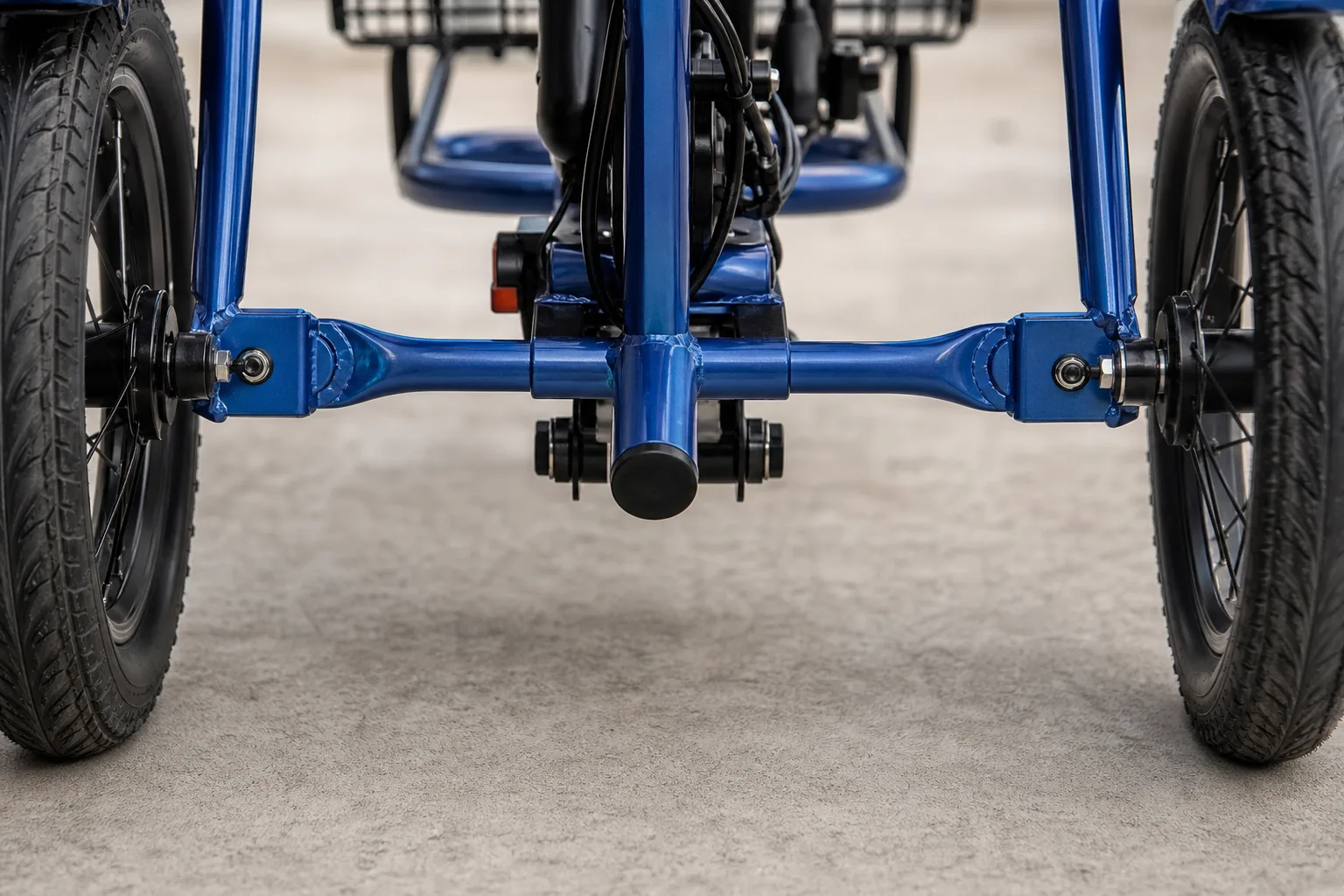
Every adult tricycle sold to a rider with balance or joint limits is described as stable, and in the narrow sense of not falling over at a stop sign, all of them are. The difference shows up at the first sharp corner taken at anything above walking pace, and it is not a matter of build quality or brand. It is geometry: where the rider's body sits in relation to the three contact patches, and how far that mass has to travel sideways before one wheel unloads. A careful shopper can work most of this out with a tape measure before signing anything.
Where the mass sits in each layout
A delta trike puts one wheel at the front and two at the back, with the rider sitting upright on a saddle, hips somewhere around thirty inches off the ground on most models. The support triangle is wide at the rear and narrows to a point at the front, and the rider's mass sits high, near the rear axle, close to the widest part but well above it. A tadpole recumbent reverses the layout: two wheels forward, one behind, the rider reclined with hips often under a foot off the pavement. The mass is low, between the front wheels, and near the broad end of the triangle again. Same three wheels, very different distances to the edge.
The tipping line and the arithmetic behind it
In a right turn, the machine pivots about the line running from the outside front contact patch to the outside rear one, and on a three-wheeler that line is a diagonal, not a side. Lateral force in the corner pushes the combined mass toward that diagonal, and the wheel lifts when the mass crosses it. The useful rule is that the tipping threshold scales with half the track width divided by the height of the center of mass. That means seat height is not a comfort preference, it is a stability input: cut the center of mass height in half on the same track, and the speed at which a wheel starts to unload rises by roughly forty percent for an identical corner. Nobody leans, in either layout. The delta simply runs out of margin sooner, which the rider feels as being thrown toward the outside of the turn.
Crowned roads, driveway aprons and other slopes you did not choose
Most American streets are crowned to shed water, and a shoulder or bike lane can carry a noticeable side slope toward the gutter. A trike does not lean into that slope the way a two-wheeler does; it sits tilted, and the mass moves permanently toward the downhill wheel, spending part of the cornering budget before the corner arrives. On a high-seated delta the effect is plain, a steady pull toward the curb that has to be steered against. On a low tadpole the same crown produces a much smaller shift, because the mass has less height to swing through. Driveway aprons, gutter pans and the transition onto a curb cut all do the same thing in a shorter, sharper dose.
The two numbers worth writing down
Track width is measured center to center at the ground, not at the widest fenders, and it is the one specification that dealers quote inconsistently, so measure it yourself with the rider seated. Seat height is measured from the pavement to the top of the cushion, again with weight on it, because foam compresses an inch or more. Those two numbers, taken together, tell you more about cornering behavior than the frame material, the motor wattage or the number of gears. A wide delta with a low, adjustable saddle can behave better than a narrow one with the seat post extended, and many deltas allow more seat-height adjustment than the showroom setup suggests. Ask for it to be dropped and try again.
What to check on the test ride
Find a parking lot with a real crown, not a level showroom floor, and ride a figure eight at the pace you actually intend to travel. Watch for the inside rear wheel going quiet or light, listen for a chirp from the tire, and note whether you are bracing with your arms to stay centered on the seat. Repeat it along a crowned street edge, and again turning off a driveway apron. The Consumer Product Safety Commission oversees bicycle safety standards in the United States, and a reputable dealer will not object to a test that puts a machine near its limits with a helmet on and nothing to hit.
The layout you end up with should follow from the corners on your own route: a low tadpole for anyone who rides crowned roads at speed, a delta with the saddle set as low as the leg length allows for anyone who values the upright seat and the easy step-through. Both answers are defensible once the tape measure has spoken.